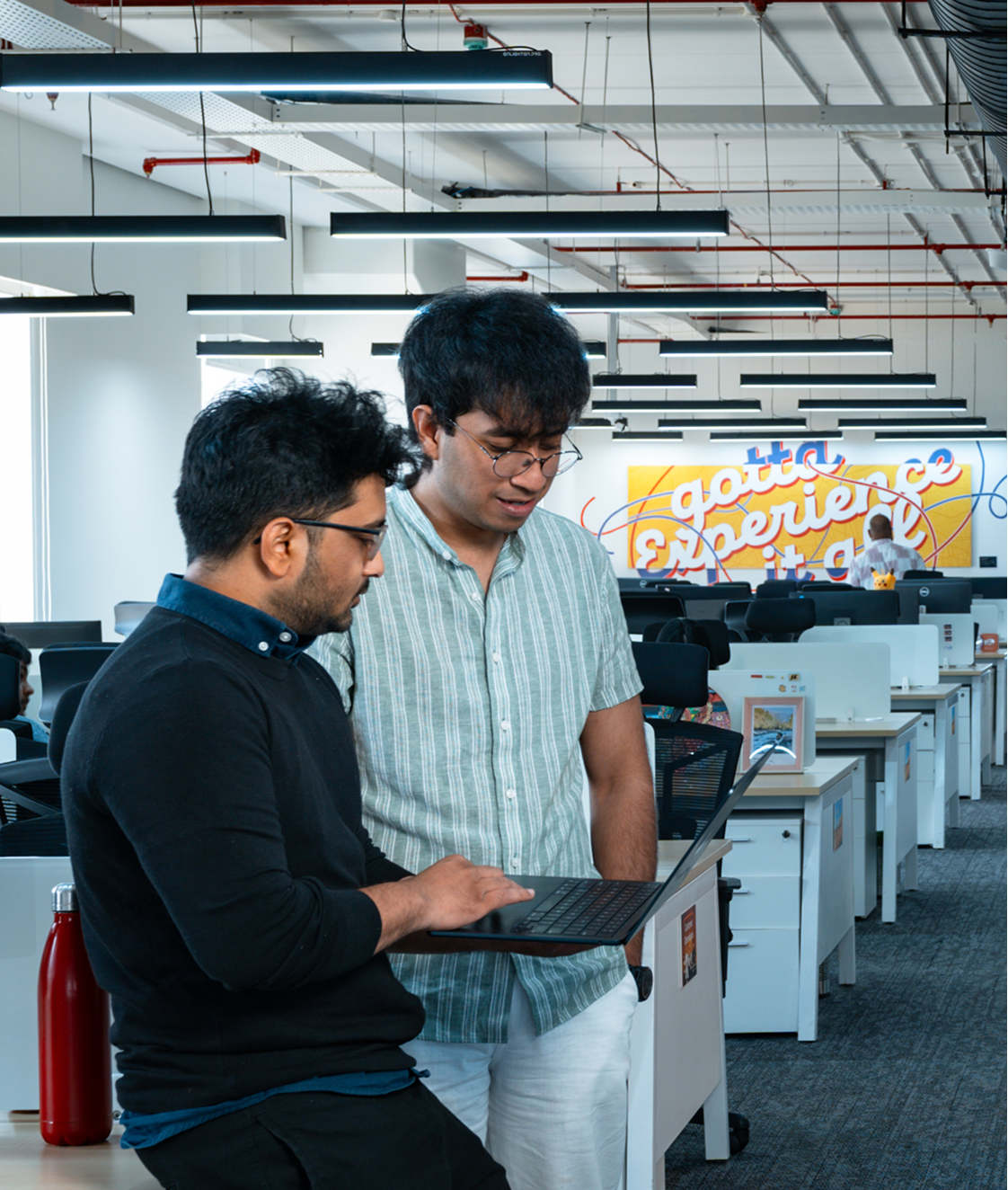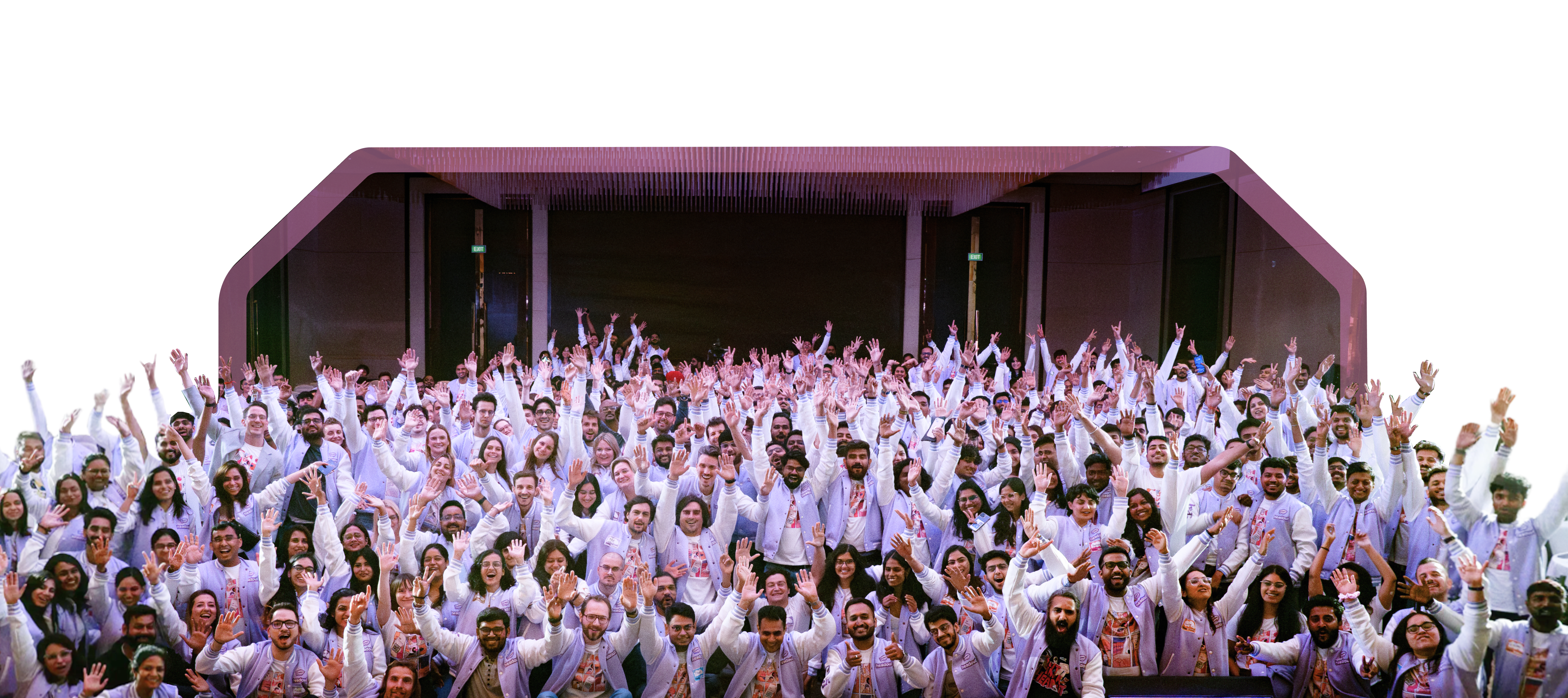
Headout is for people who want meaningful work: hard problems, high standards, and work that compounds into craft.

For all of Headout's existence, we have been driven by one simple truth: experiencing the world is fundamental to our collective happiness. Our mission is to unlock this happier world by connecting high-quality live experiences with people everywhere, giving them the opportunity to be entertained, educated, and inspired.

Delivering on that mission demands urgency, focus, ownership, and a level of craftsmanship that sets us apart. It requires that we leverage AI not as an experiment, but as a foundational operating system. And it demands optimism because nothing big is ever built by cynics. These are the behaviors our operating principles are built on.

We choose not to call these values because values without behaviors are empty. These are operating principles — a set of actions we reward, encourage, and amplify. They shape how we work, how we collaborate, and how we grow. Just as importantly, they clarify what doesn't work at Headout and what cannot be part of who we are.

These principles stem from our workplace mission: enable people to do their life's best work. This is what has set Headout apart in our first decade, and what will continue to define us in the decades to come. Our goal isn't to create the happiest workplace, it is to create the most meaningful one. A place where the work is challenging, the bar is high, and the environment is designed to help you rise to it. Happiness, we've learned, is simply a byproduct of doing great work with people you believe in.
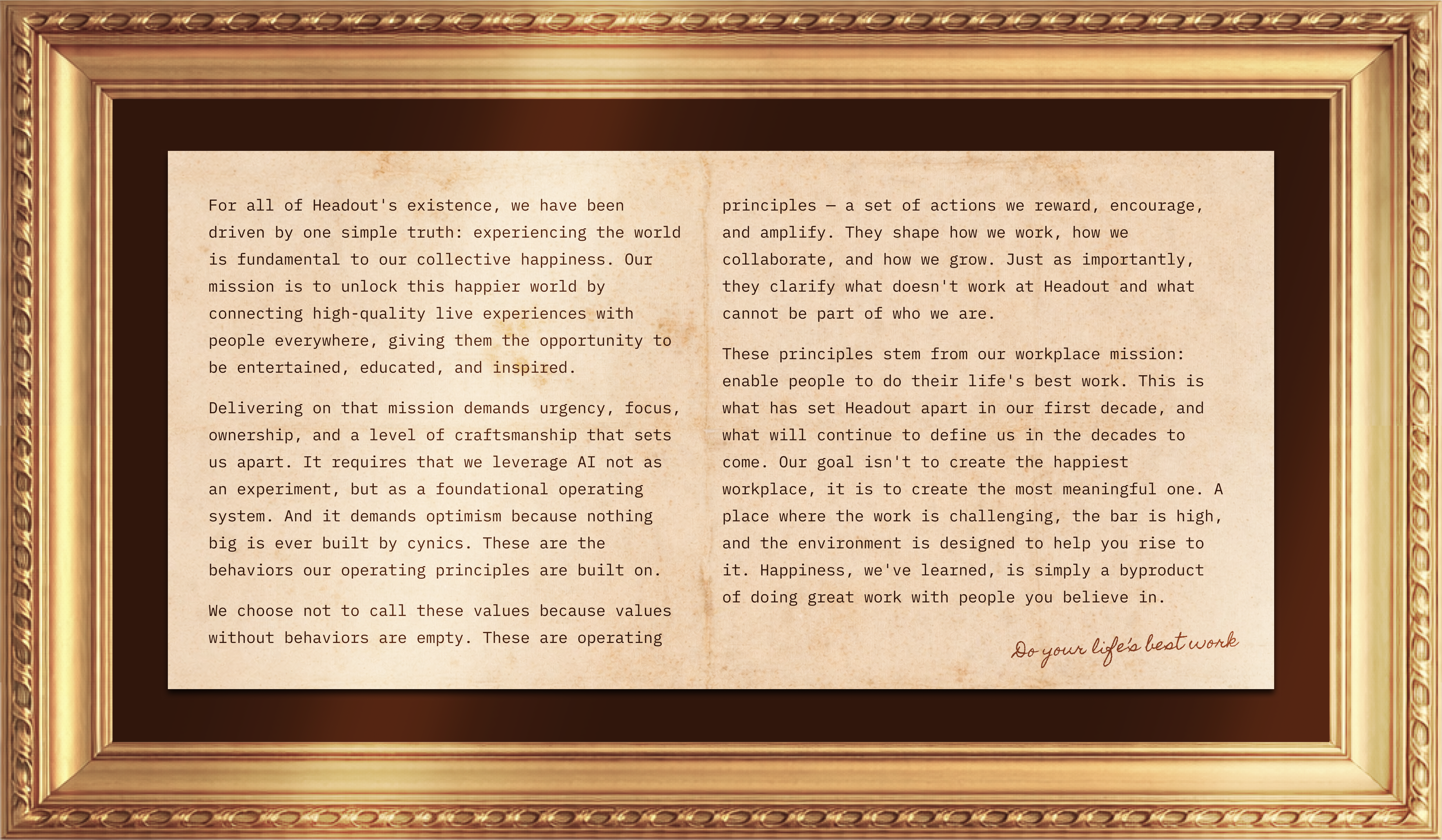

Do your life's best work

Headout > I

Our mission is a powerful one, and working at Headout is an act of service to that mission. Headout > I reminds us that this mission sits above individual preferences, egos, or silos. We are here to serve our customers, our partners, and the work, not ourselves. When faced with a choice between optimising for personal wins or doing what's right for Headout, we choose Headout. Always.

How we do it?

We choose the collective over the individual.Every trade-off begins with one question: What's best for Headout? Not what's convenient, familiar, or personally rewarding. This lens keeps us aligned, fast, and focused on what truly matters.
We are an open book.Data is open by default so everyone can see the broader context and make decisions that serve the company. Transparency goes beyond data. People are accessible, wikis are kept updated to provide context and answer questions, and discussions happen in public channels by default.
We speak the truth and commit as one.We practise radical candor by giving direct and honest feedback early, specifically, and with context because we want each other, and the company, to win. Candor is not shaming; it flows across levels and is received with humility. It keeps ego small and the mission big.
We let the best ideas win, no matter where they come from.A breakthrough can come from anyone, in any team. Titles don't matter here; merit does. Our responsibility is to notice the right idea — not the loudest one — champion it, and help it land.
We care deeply, but never cling tightly.We pour ourselves into our work, but we're always ready to evolve it, rewrite it, or let it go when something better emerges. Attachment drives craft; flexibility drives progress.
We ignore optics, titles, and hierarchy.Real influence comes from ownership and outcomes, not levels. Those who lead with humility, clarity, and contribution thrive. Those who optimise for visibility over impact don't.
Advancing our mission is not only a business imperative, it's also a moral one. Anything that distracts us from our mission will be ruthlessly cut.

Questions to ask yourself

Am I comfortable prioritising the company's success over personal credit or visibility?

Do I naturally step in when something needs fixing, even if it's not "my job"?

Can I disagree openly, then fully commit once a decision is made?

Do I care more about outcomes than optics?

Am I willing to stay with hard problems through the messy middle?

Ownership is the job description

There are companies where people step over trash on the office floor, assuming someone else will handle it. And there are companies where people instinctively stop and pick it up, the same way they would at home. We work hard to be the latter. A team where everyone feels responsible for doing what's right for the company, in every moment.

"Picking up the trash" is our metaphor for ownership. It means solving problems, big or small, without being asked and without assuming they belong to someone else. Ownership doesn't mean heroics or doing everything yourself. You fix what you can, route problems to the right owner when you can't, and stay accountable until it's resolved. You seek help early, support the person best placed to act, and see it through. This mindset isn't enforced through rules; it's cultivated until it becomes second nature.

How we do it?

We celebrate initiative, not intentions.Ownership is visible in the small things. When someone steps up and fixes an annoying problem, big or small, we recognise it publicly in #psa-kudos. It reinforces that initiative is noticed, valued, and part of who we are.
We lead from the front.Founders, managers, and individual contributors all pick up tasks outside their lanes when something needs to get done. Ownership isn't tied to expertise or job scope; it's a company-wide behaviour we model every day.
We don't report problems, we resolve them.At Headout, we don't say "if you see something, say something." We take ownership. We fix what we can, escalate what we can't, and stay with the problem until it's resolved. When escalation is necessary, including for security or legal issues, we act quickly and responsibly. This instinct helps counterbalance our bias for speed over perfection and ensures that the company keeps moving forward without unnecessary friction.
We don't hoard responsibility.True ownership scales impact through others and doesn't concentrate it in one person. We build clarity, delegate early, and design systems that remove an individual as a bottleneck.
We don't limit ownership to a room or an office.Headout is global at its core. True ownership means thinking beyond who's present, bringing in perspectives across geographies and functions, inviting the right voices into decisions, and ensuring context travels. Responsibility, not proximity, determines who has a seat at the table.

Questions to ask yourself

Do I naturally take responsibility instead of waiting to be asked?

Am I energised by ambiguous problems with no clear owner?

Can I move work forward without perfect instructions?

Do I think in systems, not just tasks?

Am I motivated by impact more than titles or formal authority?

If AI can, AI should

By now, we know AI isn't a trend, it is the most profound shift in how work gets done. We choose to be on the front edge of that shift. AI is not a nice-to-have, and it's not an experiment. It is leverage that multiplies our speed, sharpens our judgment, expands our capacity, and frees us to do higher-order work.

If a process, workflow, decision, or task can be done safely, legally, and with equal or better quality through AI, we let AI do the heavy lifting while staying fully accountable for the outcomes. Our job is not to outwork machines; it's to design systems where humans do what humans are great at: creativity, strategic judgment, storytelling, and empathy, while AI handles everything else. We actively seek opportunities to automate, standardize, and accelerate.

How we do it?

We give people the tools and credits to experiment.Being AI-first means everyone has the freedom and resources to try new models, tools, workflows, and approaches. We invest in credits, subscriptions, and experimentation budgets so teams can explore what's possible.
We recognise and reward those who push the boundaries.We actively celebrate people who go above and beyond in using AI to elevate their craft — whether it's automating a workflow, redesigning a process, improving quality, or multiplying output.
We operate as an AI-first company — in products and in workflows.AI isn't a side project at Headout; it's becoming part of our operating system. We're building Dex as a flagship AI experience for our guests, while also infusing AI across several internal workflows.

Questions to ask yourself

Am I excited by AI as leverage, not threatened by it?

Do I proactively experiment with tools to improve quality and speed?

Can I design systems that scale beyond myself?

Do I share learnings openly to raise the bar for others?

Am I curious enough to keep learning as the tools evolve?

Craft in all we do

Mediocrity is a choice, and we choose differently. At Headout, how we do something matters just as much as what we do. A craftsmanship mindset means caring about the tiny decisions no one sees, sweating the details, and refusing to settle for "good enough" when "great" is within reach.

Craft shows up in the choices people make when no one is watching: what they cut, what they keep, and what they refuse to ship. So every touchpoint — a line of copy, a Slack update, a deck slide, a feature release, a city page, a support reply, or a partner email — is an opportunity to create something that feels considered, elevated, and unmistakably Headout. When something leaves your hands, it should feel like it came from someone who genuinely gives a damn.

We are in the business of exceptional experiences. Everything we touch should move us closer to creating moments our users will remember for the rest of their lives.

How we do it?

We care about the small things.We build every touchpoint with intention, whether internal or external. A process, a doc, a product, a policy, or an interview should always ooze thought and depth. Craft signals care, and we care deeply about what we ship into the world.
We keep standards high, not timelines bloated.Craft is not about over-polishing or taking forever. It's about defaulting to a higher standard in how we think, write, design, build, and decide. When expectations are high, for ourselves and for those around us, speed and quality reinforce each other.
We stay close to the work.We prefer leaders who are close to the craft and operate at all levels. Our CTO still codes. Our CEO still reads every single customer review. Our COO still sells. At Headout, the people closest to the work are the ones driving it, because we believe great leadership comes from doing, not just directing.
We design experiences, not outputs.We don't ship assets for the sake of shipping. We ask: What will this feel like for the person on the other side? Whether it's a guest, a partner, or a teammate, the experience must feel thoughtful, coherent, and distinctly Headout.

Questions to ask yourself

Do I take pride in the quality of what I ship, even when no one is watching?

Am I thoughtful about details without getting stuck in perfectionism?

Can I balance urgency with high standards?

Do I hold myself to a higher bar than what's merely acceptable?

Urgent by design, focused by default

We move quickly because the world moves quickly. We respond fast, unblock fast, and ship fast. But speed without focus is chaos. That's why urgency must be paired with focus: knowing what truly counts, finishing what we start, and refusing to let distractions dilute our impact.

How we do it?

We aim to be the fastest company to get to the right answer.When people think of Headout, we want them to think of a team that lives in the high-speed lane — decisive, precise, and relentless in momentum.
We believe urgency leads to quality.Urgency does not come at the cost of quality. Quality is discovered through iteration, and speed accelerates that discovery. Even with deep user understanding, early attempts can go wrong. Moving fast lets us learn sooner, correct course quickly, and arrive at better outcomes with clarity and conviction.
We constantly ask: "What would it take to do this in a day?"This question reveals constraints, unlocks creativity, and prevents unnecessary drag.
We design the organisation for speed:transparent access to data so decisions don't wait on gatekeepers; clear, structured writing over meetings; public channels over DMs; docs over decks; fewer meetings and shorter meetings so time is spent building, not talking.

Questions to ask yourself

Do I bias toward action instead of waiting for perfect clarity?

Can I prioritise ruthlessly and say no to good ideas in service of great ones?

Do I communicate clearly under pressure?

Am I comfortable working in environments where momentum matters?

Do I unblock others quickly and proactively?

Optimism is more fun

Being a believer beats being a skeptic every single time. We're building something ambitious and sometimes downright difficult and we choose to build it with people who genuinely believe it's possible. Unwavering optimism is not blind positivity, wishful thinking, or ignoring reality. It's the choice to approach problems with possibility instead of fear, to imagine what could work rather than fixate on what won't.

Optimism at Headout is not about personality or cheerfulness. It is not extroversion, loud positivity, or constant enthusiasm. Optimism here is about agency: the belief that action can change outcomes, even when things are hard. We prefer irrational optimists over rational cynics because, on a long enough arc and in the right environment, optimists build more. And at Headout, we believe the world we're building is not a zero-sum game.

How we do it?

We default to possibility, not limitation.We start by asking "What would it take for this to work?" instead of listing reasons it might fail.
We are energising to work with.Optimism is contagious. We show up with curiosity, openness, and enthusiasm. This is the kind of attitude that makes people want to collaborate, build, and push together.
We build for abundance, not scarcity.We believe growth is created, not allocated. Opportunities expand as we do, for our teammates, our partners, and our users.
We stay grounded in reality.We don't sugarcoat facts or suppress bad news. We surface risks early, call out constraints clearly, and engage with reality as it is, while still believing progress is possible.
We lift each other up.We choose encouragement over cynicism, support over detachment. Being someone people like working with is part of the job.

Questions to ask yourself

Do I default to possibility instead of limitation?

Can I stay constructive and grounded under pressure?

Do I assume good intent in others?

Am I someone people enjoy building with?

Headout > I

Our mission is a powerful one, and working at Headout is an act of service to that mission. Headout > I reminds us that this mission sits above individual preferences, egos, or silos. We are here to serve our customers, our partners, and the work, not ourselves. When faced with a choice between optimising for personal wins or doing what's right for Headout, we choose Headout. Always.

How we do it

  1. We choose the collective over the individual.Every trade-off begins with one question: What's best for Headout? Not what's convenient, familiar, or personally rewarding. This lens keeps us aligned, fast, and focused on what truly matters.
  2. We are an open book.Data is open by default so everyone can see the broader context and make decisions that serve the company. Transparency goes beyond data. People are accessible, wikis are kept updated to provide context and answer questions, and discussions happen in public channels by default.
  3. We speak the truth and commit as one.We practise radical candor by giving direct and honest feedback early, specifically, and with context because we want each other, and the company, to win. Candor is not shaming; it flows across levels and is received with humility. It keeps ego small and the mission big.
  4. We let the best ideas win, no matter where they come from.A breakthrough can come from anyone, in any team. Titles don't matter here; merit does. Our responsibility is to notice the right idea — not the loudest one — champion it, and help it land.
  5. We care deeply, but never cling tightly.We pour ourselves into our work, but we're always ready to evolve it, rewrite it, or let it go when something better emerges. Attachment drives craft; flexibility drives progress.
  6. We ignore optics, titles, and hierarchy.Real influence comes from ownership and outcomes, not levels. Those who lead with humility, clarity, and contribution thrive. Those who optimise for visibility over impact don't.
  7. Advancing our mission is not only a business imperative, it's also a moral one. Anything that distracts us from our mission will be ruthlessly cut.

Questions to ask yourself

  1. Am I comfortable prioritising the company's success over personal credit or visibility?
  2. Do I naturally step in when something needs fixing, even if it's not "my job"?
  3. Can I disagree openly, then fully commit once a decision is made?
  4. Do I care more about outcomes than optics?
  5. Am I willing to stay with hard problems through the messy middle?

Ownership is the job description

There are companies where people step over trash on the office floor, assuming someone else will handle it. And there are companies where people instinctively stop and pick it up, the same way they would at home. We work hard to be the latter. A team where everyone feels responsible for doing what's right for the company, in every moment.

"Picking up the trash" is our metaphor for ownership. It means solving problems, big or small, without being asked and without assuming they belong to someone else. Ownership doesn't mean heroics or doing everything yourself. You fix what you can, route problems to the right owner when you can't, and stay accountable until it's resolved. You seek help early, support the person best placed to act, and see it through. This mindset isn't enforced through rules; it's cultivated until it becomes second nature.

How we do it

  1. We celebrate initiative, not intentions.Ownership is visible in the small things. When someone steps up and fixes an annoying problem, big or small, we recognise it publicly in #psa-kudos. It reinforces that initiative is noticed, valued, and part of who we are.
  2. We lead from the front.Founders, managers, and individual contributors all pick up tasks outside their lanes when something needs to get done. Ownership isn't tied to expertise or job scope; it's a company-wide behaviour we model every day.
  3. We don't report problems, we resolve them.At Headout, we don't say "if you see something, say something." We take ownership. We fix what we can, escalate what we can't, and stay with the problem until it's resolved. When escalation is necessary, including for security or legal issues, we act quickly and responsibly. This instinct helps counterbalance our bias for speed over perfection and ensures that the company keeps moving forward without unnecessary friction.
  4. We don't hoard responsibility.True ownership scales impact through others and doesn't concentrate it in one person. We build clarity, delegate early, and design systems that remove an individual as a bottleneck.
  5. We don't limit ownership to a room or an office.Headout is global at its core. True ownership means thinking beyond who's present, bringing in perspectives across geographies and functions, inviting the right voices into decisions, and ensuring context travels. Responsibility, not proximity, determines who has a seat at the table.

Questions to ask yourself

  1. Do I naturally take responsibility instead of waiting to be asked?
  2. Am I energised by ambiguous problems with no clear owner?
  3. Can I move work forward without perfect instructions?
  4. Do I think in systems, not just tasks?
  5. Am I motivated by impact more than titles or formal authority?

If AI can, AI should

By now, we know AI isn't a trend, it is the most profound shift in how work gets done. We choose to be on the front edge of that shift. AI is not a nice-to-have, and it's not an experiment. It is leverage that multiplies our speed, sharpens our judgment, expands our capacity, and frees us to do higher-order work.

If a process, workflow, decision, or task can be done safely, legally, and with equal or better quality through AI, we let AI do the heavy lifting while staying fully accountable for the outcomes. Our job is not to outwork machines; it's to design systems where humans do what humans are great at: creativity, strategic judgment, storytelling, and empathy, while AI handles everything else. We actively seek opportunities to automate, standardize, and accelerate.

How we do it

  1. We give people the tools and credits to experiment.Being AI-first means everyone has the freedom and resources to try new models, tools, workflows, and approaches. We invest in credits, subscriptions, and experimentation budgets so teams can explore what's possible.
  2. We recognise and reward those who push the boundaries.We actively celebrate people who go above and beyond in using AI to elevate their craft — whether it's automating a workflow, redesigning a process, improving quality, or multiplying output.
  3. We operate as an AI-first company — in products and in workflows.AI isn't a side project at Headout; it's becoming part of our operating system. We're building Dex as a flagship AI experience for our guests, while also infusing AI across several internal workflows.

Questions to ask yourself

  1. Am I excited by AI as leverage, not threatened by it?
  2. Do I proactively experiment with tools to improve quality and speed?
  3. Can I design systems that scale beyond myself?
  4. Do I share learnings openly to raise the bar for others?
  5. Am I curious enough to keep learning as the tools evolve?

Craft in all we do

Mediocrity is a choice, and we choose differently. At Headout, how we do something matters just as much as what we do. A craftsmanship mindset means caring about the tiny decisions no one sees, sweating the details, and refusing to settle for "good enough" when "great" is within reach.

Craft shows up in the choices people make when no one is watching: what they cut, what they keep, and what they refuse to ship. So every touchpoint — a line of copy, a Slack update, a deck slide, a feature release, a city page, a support reply, or a partner email — is an opportunity to create something that feels considered, elevated, and unmistakably Headout. When something leaves your hands, it should feel like it came from someone who genuinely gives a damn.

We are in the business of exceptional experiences. Everything we touch should move us closer to creating moments our users will remember for the rest of their lives.

How we do it

  1. We care about the small things.We build every touchpoint with intention, whether internal or external. A process, a doc, a product, a policy, or an interview should always ooze thought and depth. Craft signals care, and we care deeply about what we ship into the world.
  2. We keep standards high, not timelines bloated.Craft is not about over-polishing or taking forever. It's about defaulting to a higher standard in how we think, write, design, build, and decide. When expectations are high, for ourselves and for those around us, speed and quality reinforce each other.
  3. We stay close to the work.We prefer leaders who are close to the craft and operate at all levels. Our CTO still codes. Our CEO still reads every single customer review. Our COO still sells. At Headout, the people closest to the work are the ones driving it, because we believe great leadership comes from doing, not just directing.
  4. We design experiences, not outputs.We don't ship assets for the sake of shipping. We ask: What will this feel like for the person on the other side? Whether it's a guest, a partner, or a teammate, the experience must feel thoughtful, coherent, and distinctly Headout.

Questions to ask yourself

  1. Do I take pride in the quality of what I ship, even when no one is watching?
  2. Am I thoughtful about details without getting stuck in perfectionism?
  3. Can I balance urgency with high standards?
  4. Do I hold myself to a higher bar than what's merely acceptable?

Urgent by design, focused by default

We move quickly because the world moves quickly. We respond fast, unblock fast, and ship fast. But speed without focus is chaos. That's why urgency must be paired with focus: knowing what truly counts, finishing what we start, and refusing to let distractions dilute our impact.

How we do it

  1. We aim to be the fastest company to get to the right answer.When people think of Headout, we want them to think of a team that lives in the high-speed lane — decisive, precise, and relentless in momentum.
  2. We believe urgency leads to quality.Urgency does not come at the cost of quality. Quality is discovered through iteration, and speed accelerates that discovery. Even with deep user understanding, early attempts can go wrong. Moving fast lets us learn sooner, correct course quickly, and arrive at better outcomes with clarity and conviction.
  3. We constantly ask: "What would it take to do this in a day?"This question reveals constraints, unlocks creativity, and prevents unnecessary drag.
  4. We design the organisation for speed:transparent access to data so decisions don't wait on gatekeepers; clear, structured writing over meetings; public channels over DMs; docs over decks; fewer meetings and shorter meetings so time is spent building, not talking.

Questions to ask yourself

  1. Do I bias toward action instead of waiting for perfect clarity?
  2. Can I prioritise ruthlessly and say no to good ideas in service of great ones?
  3. Do I communicate clearly under pressure?
  4. Am I comfortable working in environments where momentum matters?
  5. Do I unblock others quickly and proactively?

Optimism is more fun

Being a believer beats being a skeptic every single time. We're building something ambitious and sometimes downright difficult and we choose to build it with people who genuinely believe it's possible. Unwavering optimism is not blind positivity, wishful thinking, or ignoring reality. It's the choice to approach problems with possibility instead of fear, to imagine what could work rather than fixate on what won't.

Optimism at Headout is not about personality or cheerfulness. It is not extroversion, loud positivity, or constant enthusiasm. Optimism here is about agency: the belief that action can change outcomes, even when things are hard. We prefer irrational optimists over rational cynics because, on a long enough arc and in the right environment, optimists build more. And at Headout, we believe the world we're building is not a zero-sum game.

How we do it

  1. We default to possibility, not limitation.We start by asking "What would it take for this to work?" instead of listing reasons it might fail.
  2. We are energising to work with.Optimism is contagious. We show up with curiosity, openness, and enthusiasm. This is the kind of attitude that makes people want to collaborate, build, and push together.
  3. We build for abundance, not scarcity.We believe growth is created, not allocated. Opportunities expand as we do, for our teammates, our partners, and our users.
  4. We stay grounded in reality.We don't sugarcoat facts or suppress bad news. We surface risks early, call out constraints clearly, and engage with reality as it is, while still believing progress is possible.
  5. We lift each other up.We choose encouragement over cynicism, support over detachment. Being someone people like working with is part of the job.

Questions to ask yourself

  1. Do I default to possibility instead of limitation?
  2. Can I stay constructive and grounded under pressure?
  3. Do I assume good intent in others?
  4. Am I someone people enjoy building with?

We're not a perfect company. We don't have a perfect culture. It is a work in progress, and our playbook will continue to evolve as we grow.

Going forward, these six principles (and future refinements) are now the primary lens through which we hire, assess performance, give feedback, and resolve disagreements.

Let's work together to make Headout the place where all of us end up doing our life's best work 💜